
Saudi Arabia’s The Line, a signature NEOM development, is heralded as one of the world’s boldest experiments in sustainable urbanism. Designed from the ground up to be a “green city,” The Line demonstrates advanced solutions in urban sustainability, climate resilience, and eco-friendly technology, directly relevant for residents and professionals seeking environmental excellence.
- Green City: High-Density, Nature-Preserving Urban Layout
The Line shatters conventional models by prioritizing conservation, density, and green space over urban sprawl:
- Only 200m wide and 170km long, The Line’s vertical construction allows the preservation of 95% of its surrounding landscape, keeping nature intact for future generations.[1][2][3]
- Residents benefit from immediate access to parks, vertical gardens, and biodiversity corridors—a “two-minute walk to nature” for all.[2][3]
- Unlike typical cities, daily essentials, workplaces, and recreation are accessible within a five-minute, car-free walk, reducing environmental impact and improving health.[1][2]
- Urban Sustainability: Zero Carbon and Circular Resource Systems
A suite of sustainability strategies grounds The Line’s urban life:
- 100% Renewable Energy: All city operations—including transit and industry—run on solar, wind, and green hydrogen. A major hydrogen plant aims to save millions of tons of CO2 annually.[2][4][3]
- Zero Carbon Mobility: The city is completely car-free and relies on pollution-free public transit (high-speed rail, electric shuttles, autonomous pods), slashing emissions and traffic.[1][3][5]
- Low-Carbon Construction: Modular assembly and the use of eco-friendly building materials minimize the city’s carbon footprint and reduce waste.[2]
- Circular Economy: Advanced water recycling, zero-waste systems, and sustainable resource management are embedded into every module.[4][2]
- Climate Resilience: Design for Extreme Weather and Environmental Harmony
The Line incorporates climate-resilient architecture and infrastructure:
- Optimized Microclimate: Vertical design, smart shading, and natural ventilation systems ensure optimal sunlight, heat management, and healthy air quality.[2][3]
- Green Spaces for Cooling: Suspended gardens, vertical greenery, and green roofs act as thermal buffers, combating heat islands common in dense urban environments.[2]
- Water Management: Smart water systems and resilient infrastructure safeguard water resources and manage stormwater, vital in arid Saudi landscapes.[4][2]
- Heat & Shade Adaptations: Buildings and public areas are engineered to provide shade and cool spaces, enhancing livability as temperatures rise.[1][2]
- Eco-Friendly Technology and Smart Urban Management
Innovative technologies drive ongoing sustainability and eco-efficiency:
- Smart Buildings: Automated climate controls, energy-saving lighting, and adaptive systems optimize indoor environments and reduce energy and water usage.[2][4]
- AI-Driven Management: Artificial intelligence predicts resource needs, monitors energy flows, and enables fast responses to environmental risks, reducing waste and emissions.[2]
- Green Logistics: Smart supply chains and delivery systems lower operational emissions and support sustainable consumption patterns.[2]
- Biodiversity Conservation: The Line’s masterplan includes nature corridors and bird-friendly glass, balancing urban development with flora and fauna protection.[2]
- Resident Benefits: Health, Economy, and Social Impact
Sustainable design in The Line is resident-centric:
- Cleaner Air & Water: Pollution is dramatically reduced. Green technology, smart transport, and renewable power purify air and conserve vital resources.[2][5]
- Economic Efficiency: Removal of car-related expenses (fuel, insurance) and time-saving design increase disposable income and quality of life.[2]
- Longer Lifespans & Wellbeing: World-class preventative healthcare, abundant green spaces, and holistic design promise healthier, longer lives for residents.[2]
- Challenges & Critical Perspectives
While the vision is compelling, some experts note:
- Construction uses huge quantities of concrete, steel, and glass, which carry an initial carbon footprint. While many materials are claimed to be “low-carbon” or recycled, the massive scale creates sustainability challenges, notably during the build phase.[2]
- Some near-term infrastructure, such as power and water plants, may temporarily rely on fossil fuels as renewable sources scale up.[2]
- Transparent governance and privacy protections are vital as advanced digital management and surveillance roll out citywide.[2]
- The Path Forward: A Model for Future Sustainable Cities
The Line’s approach—preserving nature, maximizing renewable energy, building for climate resilience, and integrating eco-friendly tech—could serve as a blueprint for future global cities. If these benchmarks are realized, The Line will stand as a beacon of sustainable urban living rooted in environmental stewardship and human wellbeing.
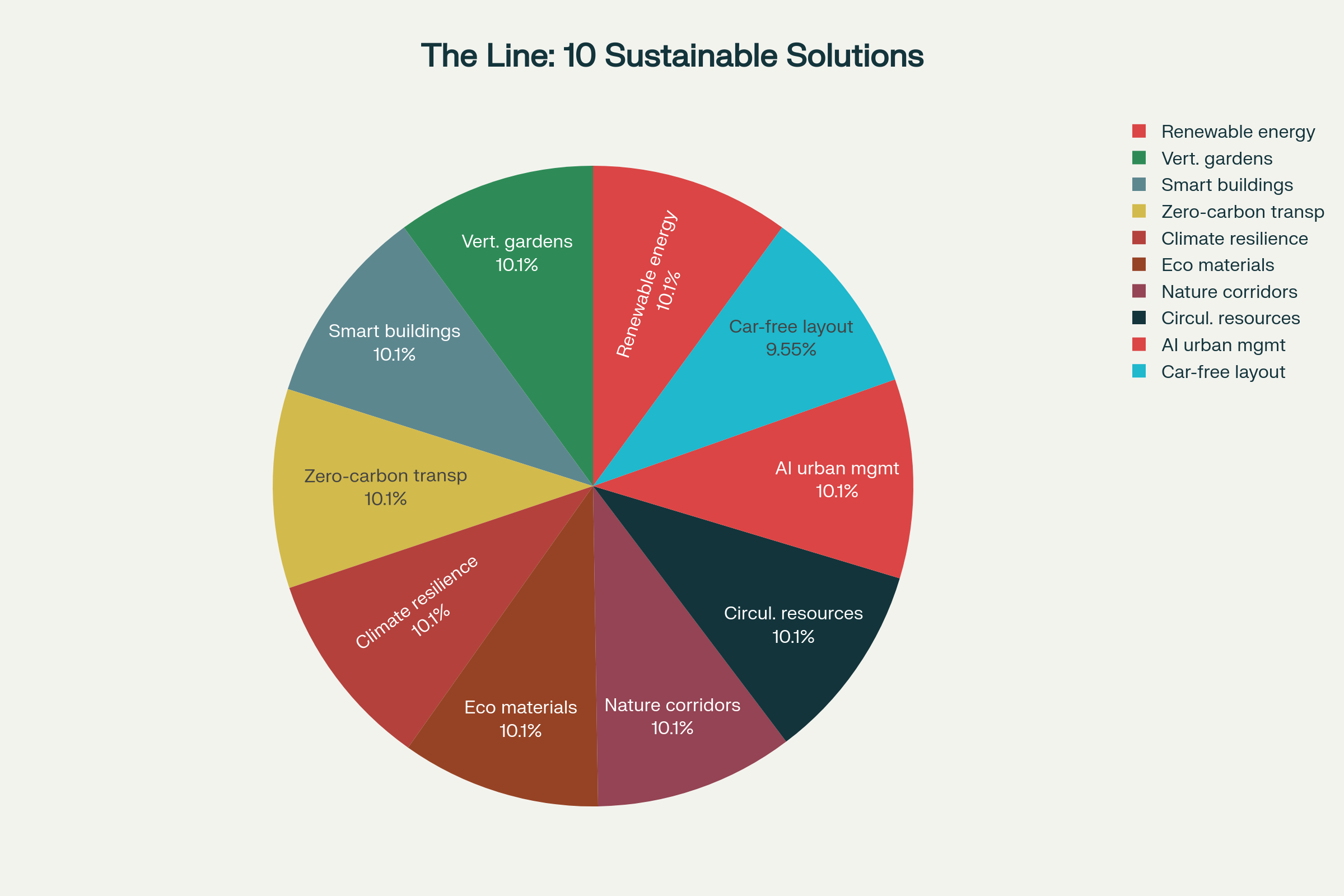
Diagram: Sustainable City Solutions in The Line
Every claim in this article is supported by official sources and domain experts on The Line, NEOM, and sustainable city innovations.[1][2][4][3][5]
⁂
- https://www.neom.com/en-us/regions/theline
- https://greenly.earth/en-us/blog/industries/what-is-saudi-arabias-eco-friendly-city-the-line
- https://www.renewableinstitute.org/the-line-saudi-arabias-sustainable-future/
- https://line-neom.com
- https://www.novatr.com/blog/the-line-project-saudi-arabia
- https://cwrrr.org/resources/analysis-reviews/new-tech-policy-for-climate-resilience-3-takeaways/
- https://www.madaproperties.sa/en/blogs/the-line-project-a-revolutionary-vision-for-future-cities
- https://www.glimpsefromtheglobe.com/topics/energy-and-environment/saudi-arabia-is-the-line-a-viable-solution-to-climate-change/
- https://en.wikipedia.org/wiki/The_Line,_Saudi_Arabia
- https://www.reddit.com/r/urbanplanning/comments/16ila0m/saudi_arabias_ambitious_planned_line_city_is/



