
Digital Government & Smart Services in The Line: Building the Future of Urban Citizenship in Saudi Arabia
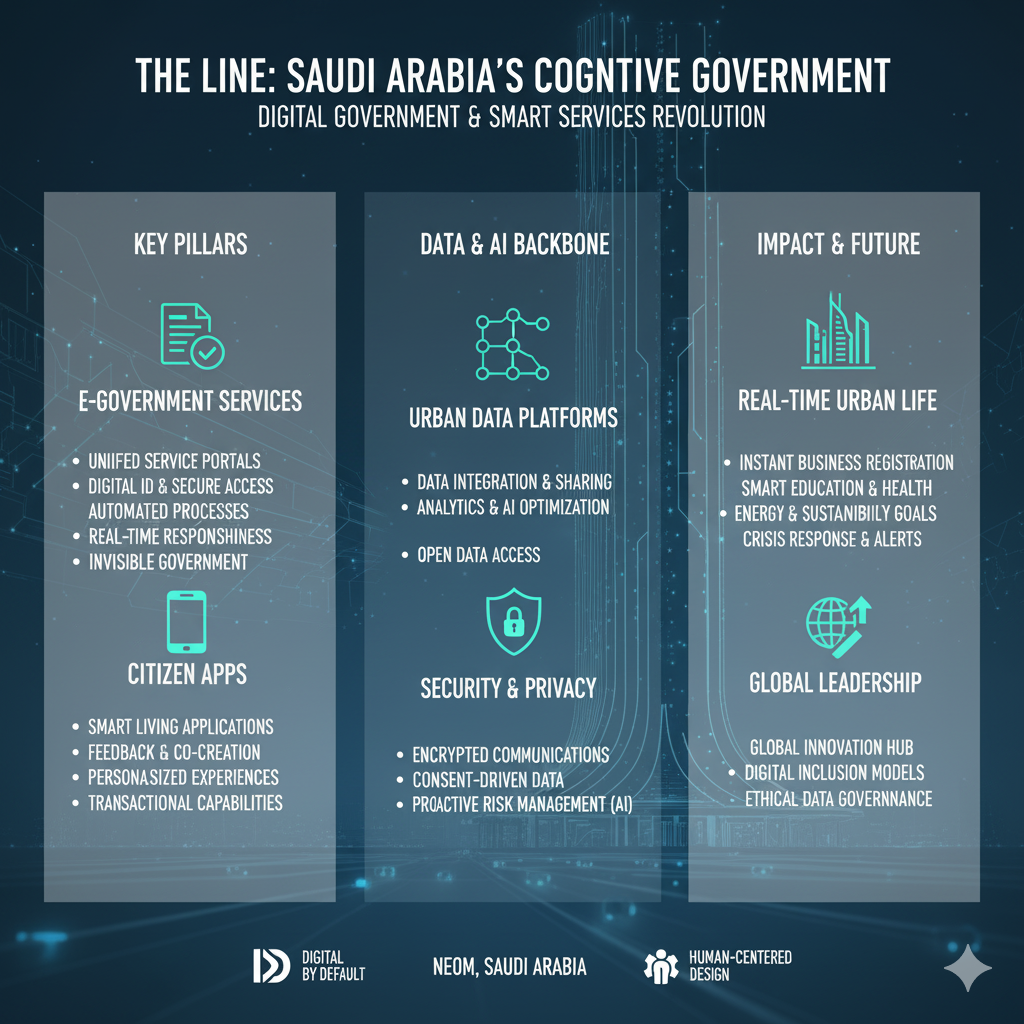
Her child’s public school records are updated in real time, and personalized educational resources arrive through secure learning apps.
- She tracks her home energy consumption, sets sustainability goals, and receives incentives for reducing carbon emissions via smart meters and apps integrated with the city’s data platform.[1]
- When a streetlight malfunctions or a public service fails, she simply snaps a photo and reports it via a citizen app, tracking resolution progress and providing feedback.
- During emergencies, she receives targeted notifications and automatic service adjustments—thanks to real-time monitoring and predictive analytics.[2][1]
These scenarios highlight the practical, transformative role of digital government and smart services in everyday city life.
Challenges and the Path Forward
Despite progress, several challenges remain:
- Digital Inclusion: Ensuring that all residents, regardless of age, language, or ability, can access and understand digital services is crucial.
- Continuous Innovation: Technology evolves rapidly; digital platforms must be updated and expanded to accommodate new needs.
- Change Management: Transitioning from traditional bureaucracy to digital-first governance requires re-training public servants, adapting legal frameworks, and managing social expectations.
- Ethical Data Use: Balancing data-driven efficiency with privacy and preventing misuse is a constant concern requiring vigilant oversight.
The Line will serve as a living laboratory for these challenges, pioneering new models for digital inclusion and ethical governance.
Looking Ahead: Toward a Global Model
The Line’s digital government and smart services approach will influence smart city design worldwide. As governments increasingly realize the benefits of “digital by default”—efficiency, transparency, citizen empowerment—the world will look to Saudi Arabia’s NEOM and The Line for best practices.
Digital government, e-government services, citizen apps, and urban data platforms are the four pillars on which cities of the future will build responsive, resilient, and inclusive societies. By investing deeply in these areas, The Line promises a paradigm shift—not only in urban living, but also in how global societies think about citizenship, governance, and innovation.[9][5][6][1]
⁂
- https://www.neom.com/en-us/regions/theline
- https://www.parsons.com/contracts/the-line-at-neom/
- https://dga.gov.sa/en/about-DGA
- https://saudipedia.com/en/article/323/government-and-politics/commissions/digital-government-authority
- https://www.spa.gov.sa/en/N2363772
- https://soulofsaudi.com/saudi-arabia-ranks-first-in-e-government-services/
- https://www.azeusconvene.com/en-sa/articles/what-is-digital-governance-saudi-arabia
- https://www.sciencedirect.com/science/article/abs/pii/S1877916617302047
- https://dga.gov.sa/en/news/digital-government-continues-whole-of-government-program
