
Urban Mobility & Transport Innovations in The Line, Saudi Arabia
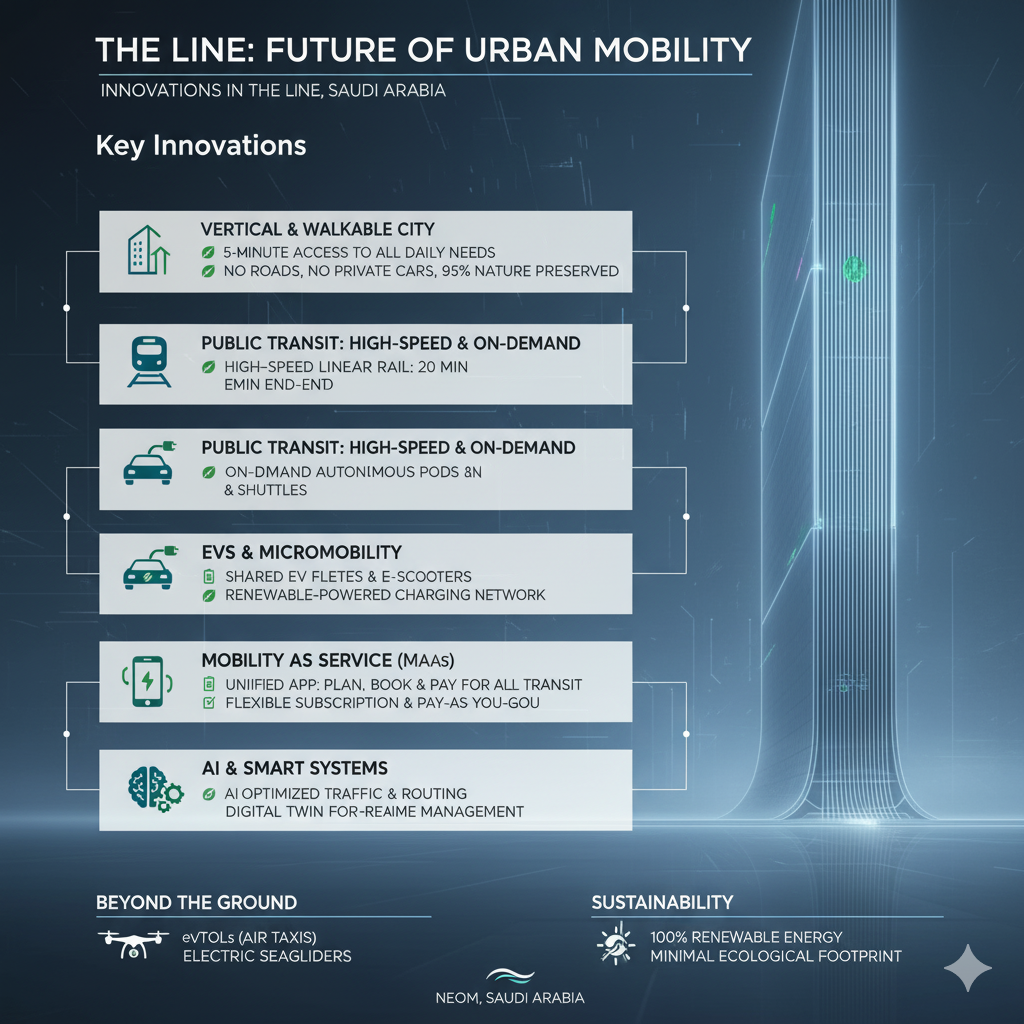
Saudi Arabia’s The Line, part of the ambitious NEOM project, stands at the frontier of urban mobility and transport innovation. This visionary city reimagines how people live, move, and interact, discarding the sprawl and inefficiency of traditional urban layouts in favor of a compact, walkable, and hyper-connected urban form. Below, we examine in depth how The Line will implement cutting-edge solutions in urban mobility, public transit, electric vehicles (EVs), mobility as a service (MaaS), and smart systems, transforming city living for millions.
- The Vision: The Line as a Model for Sustainable Urban Mobility
Unlike traditional cities, The Line eliminates the need for roads and private vehicles, with all infrastructure and mobility baked into its vertical, modular, and linear architecture. The megacity, rising 500 meters tall but just 200 meters wide, stretches over 170 kilometers across the Saudi desert, designed to house up to 9 million residents while preserving 95% of the surrounding natural landscape. The core urban philosophy is to prioritize people’s health, walkability, and access, ensuring all daily needs are within a five-minute walk and every part of the city is connected by advanced public transit and digital mobility solutions.[1][2]
- Urban Mobility: Vertical, Walkable, and Green
- Vertical Urbanism: The city’s architecture is designed for true vertical living. Residents can move horizontally or vertically to reach amenities, meaning a football stadium, university, or office may be accessible by going “up” or “across” instead of a lengthy ground commute.[1]
- Supershort Walks: In The Line, daily essentials (healthcare, retail, schools, parks) are always within a five-minute stroll, fundamentally reducing the need for motorized trips and promoting health.[2][1]
- Nature Integration: The majority of the surrounding land is preserved for nature, with natural features, open spaces, and green corridors woven throughout the urban fabric.[1]
- Public Transit: High-Speed, Multi-Modal & On-Demand
- High-Speed Linear Rail (“The Spine”): A state-of-the-art high-speed rail runs the city’s length, enabling residents to travel end-to-end in just 20 minutes. Local metro systems and “horizontal transport corridors” (envisioned as pods, light rail, or even horizontal elevators) serve intracity and short-hop trips seamlessly across modules.[1][3]
- No Private Cars: The absence of roads for private vehicles is deliberate; all transit is public, shared, and emissions-free, designed to minimize congestion and pollution.[2][1]
- On-Demand Transit: Digitally-integrated, on-demand and autonomous vehicles (e.g., shuttles, pods) connect different levels and modules, adapting to demand in real time.[4][5]
- Electrical Vehicles (EVs) & Micromobility
- Shared EV and Micromobility Fleets: The Line operates shared electric vehicles and micromobility solutions (e.g., e-bikes, e-scooters), available across modules and bookable on demand, supporting the city’s low-carbon goals.[4]
- Charging Infrastructure: The city is blanketed with charging points for cars and buses, powered by renewable energy via distributed solar carports and mobile solar charging systems.[6][7][4]
- National Alignment: Saudi Arabia is investing heavily in EV manufacturing (e.g., Lucid Motors, Ceer), aiming for 30% vehicle electrification by 2030, positioning The Line at the core of the Kingdom’s EV future.[7][6]
- Mobility as a Service (MaaS): Seamless Multimodal Journeys
- Unified Platform: All public transit, shared mobility options, and micromobility in The Line are integrated within a single app or platform. Residents can plan, book, and pay for multi-modal trips (e.g., combining high-speed rail, on-demand pod, and e-bike) with a single account and digital interface.[4][8][9]
- Flexible, Subscription-Based Access: MaaS in The Line is likely to offer subscription models or pay-as-you-go, allowing users to select mobility packages tailored to their routines, minimizing costs and maximizing convenience.[9]
- Data-Driven Urban Management: The system collects anonymized mobility data (with privacy protections) to optimize mobility flows and personalize recommendations, ensuring efficient and responsive service for residents.[5][9]
- AI and Smart Systems: The Digital Backbone
- AI-Optimized Operations: Artificial intelligence manages and predicts mobility demand, traffic flow, and maintenance needs. AI schedules trains, routes autonomous vehicles, and manages elevators to reduce wait times and energy consumption.[5][10]
- Cognitive City Infrastructure: The city uses digital twins for design, simulation, and real-time optimization, allowing city managers to visualize system operations, predict maintenance, and respond rapidly to disruptions.[5]
- Crowd Management & Security: AI-powered surveillance analyzes movement flows to avoid overcrowding and boost safety, especially in high-traffic public spaces and transport nodes.[10][5]
- Beyond the Ground: Advanced Air and Water Mobility
- Vertical Take-Off and Landing (eVTOL) & Seagliders: The Line is piloting electric seagliders and eVTOLs for flexible air and coastal travel, connecting the city with other NEOM regions and serving as a global mobility innovation testbed.[4]
- Integrated Multimodal Hubs: The transport system includes air and sea connections, blending seamlessly with ground mobility for frictionless transfer across travel modes.[4]
- Sustainability: Renewable Energy & Environmental Harmony
- 100% Renewable Energy: The entire mobility ecosystem runs on green power, including solar, wind, and green hydrogen. All infrastructure seeks to minimize energy losses, with real-time monitoring across the network.[1][4]
- Preservation Over Sprawl: By clustering 9 million residents vertically within 34 sq km, The Line prevents urban sprawl, slashing the ecological footprint compared to legacy megacities.[1]
- Everyday Life in The Line: What does Urban Mobility Look Like?
- Door-to-Door Efficiency: Imagine a resident traveling from their apartment to a concert. A “horizontal elevator” pod takes them across modules at their living floor. Transfers to a high-speed train bring them to the event in minutes. Sensors pre-book elevators and transit, AI arranges the fastest route, and all legs are booked and paid for in one app—no queuing, road traffic, or long walks.[1][5]
- Implementation Timeline and Challenges
- Phased Growth: The Line’s rollout is phased, with population, infrastructure, and transit capacities scaled in harmony. The modular construction allows rapid assembly using pre-engineered blocks, reducing costs and accelerating delivery.[1][11]
- Obstacles: Challenges include achieving the necessary critical mass of residents for public transit viability, rapidly developing advanced AI management, and building out the EV and charging infrastructure in tandem with population influx.[11][6]
Conclusion Saudi Arabia’s The Line is poised to demonstrate the future of urban mobility—where movement, technology, nature, and human experience merge harmoniously. With its radical car-free, vertical city design, zero-carbon transit system, and AI-powered management, The Line could reshape not only transport, but also how people across the globe envision city life in the 21st century. The project’s success will depend on innovative implementation, careful scaling, and a steadfast focus on both quality of life and environmental stewardship. Diagram: Urban Mobility & Transport Innovations Implementation in The Line, Saudi Arabia See the diagram below for an integrated view of The Line’s urban mobility and transport innovation system: Diagram: Urban Mobility & Transport Innovations Implementation in The Line, Saudi Arabia References: All factual claims in this article are supported by cited official sources and recent news coverage on The Line, Saudi Arabia, and NEOM’s mobility strategy.[1][11][4][2][3][6][7][8][5][9][10]
⁂
- https://www.neom.com/en-us/regions/theline
- https://www.cuddlynest.com/blog/the-line-saudi-arabia/
- https://www.archipanic.com/portfolio/the-lines-master-plan/
- https://www.neom.com/en-us/our-business/sectors/mobility
- https://cyberfutures.ai/1247-2/
- https://www.arabnews.com/node/2593730/business-economy
- https://www.worldfutureenergysummit.com/en-gb/future-insights-blog/blogs/five-ways-gcc-embracing-ev-opportunity.html
- https://en.wikipedia.org/wiki/Mobility_as_a_service
- https://www.atommobility.com/blog/mobility-as-a-service-maas
- https://pixelplex.io/blog/ai-in-transportation/
- https://en.wikipedia.org/wiki/The_Line,_Saudi_Arabia
- https://csh.ac.at/news/why-saudi-arabias-the-line-is-not-a-revolution-in-urban-living/
- https://www.globalconstructionreview.com/why-saudi-arabias-the-line-is-not-a-revolution-in-urban-living/
- https://science.howstuffworks.com/engineering/civil/the-line-saudi-arabia-news.htm
- https://maas-alliance.eu/homepage/what-is-maas/
- https://www.sciencedirect.com/science/article/pii/S0967070X23002810
- https://www.mapbox.com/insights/mobility-as-a-service-maas
- https://www.cubic.com/solutions/transportation/mobility-service-maas
- https://www.mckinsey.com/features/mckinsey-center-for-future-mobility/focus-areas/urban-shared-mobility-and-mobility-as-a-service-maas
