
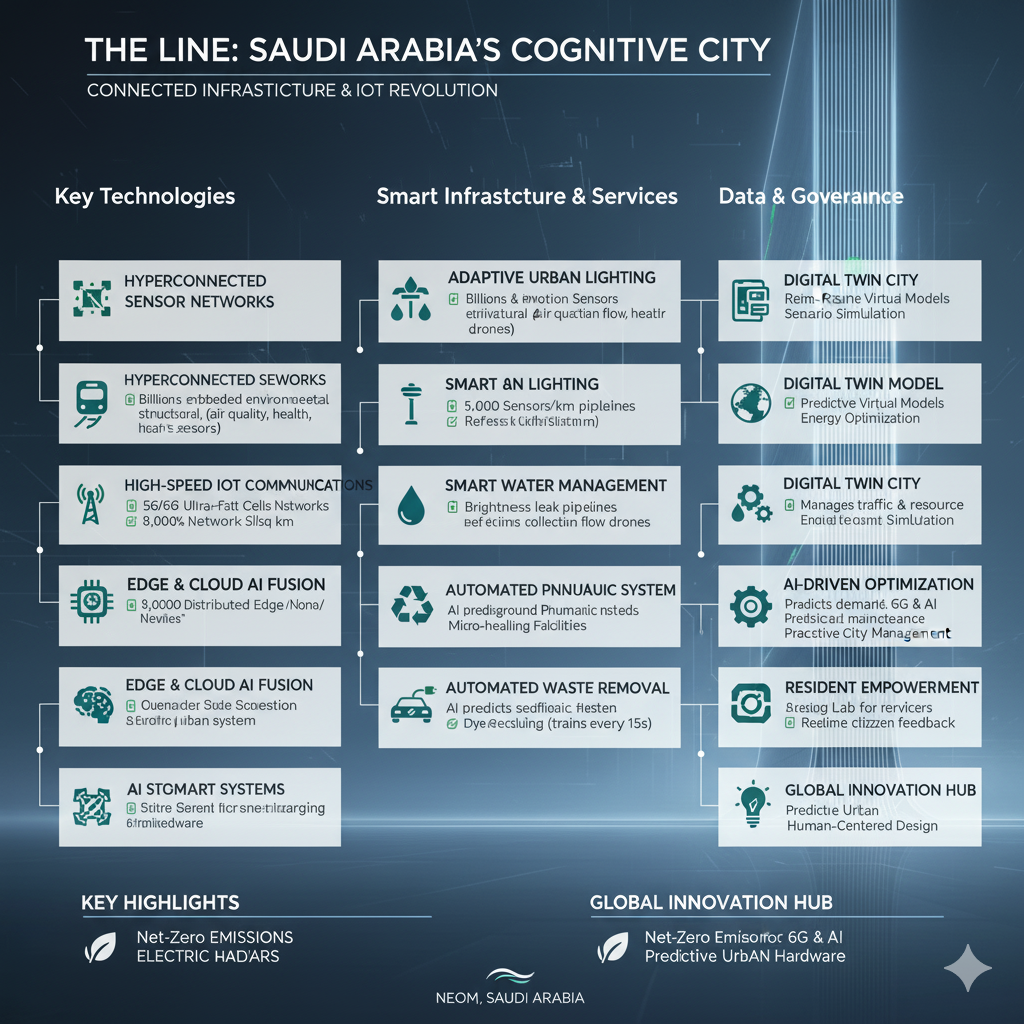
The Line—Saudi Arabia’s ultra-ambitious smart city—is poised to set new global standards for urban intelligence. At its heart lies a seamless network of connected devices, advanced smart infrastructure, and transformative IoT urban solutions, powering everyday life, city operations, and urban sustainability. This article explores the landscape, technologies, and implementation of connected infrastructure & IoT in The Line, with particular focus on sensors, adaptive lighting, data-driven services, and the cognitive city ecosystem.
- Introduction: The Vision for The Line
The Line, a signature development of NEOM and part of Saudi Vision 2030, is conceived as a 170-kilometer-long, completely car-free city. Its unique layout—a pair of mirrored towers just 200 meters wide and 500 meters tall—will accommodate nine million residents with all daily needs within a five-minute walk. The city’s connected infrastructure and IoT systems will underpin its zero-carbon, automated, and highly efficient environment, making life smarter, safer, and more sustainable.[1][2]
- The Pillars of Connected Infrastructure in The Line
- Hyperconnected Sensor Networks
- Physical Sensor Networks: Billions of smart sensors are embedded throughout The Line’s infrastructure, monitoring air quality, water flow, energy use, structural integrity, waste levels, and more. Environmental sensors track 78 different air parameters, while nano-electromechanical systems watch over building stress and safety.[2]
- Biometric Mesh: Hundreds of thousands of facial recognition cameras and wearables (integrated with epidermal electronics) gather data for crowd management, safety, and public health, all while aiming for robust privacy protections.[2]
- Smart Lighting & Adaptive Urban Services
- Adaptive Lighting: Using LIDAR and motion sensors, city lighting intelligently adjusts brightness based on pedestrian flows and lunar cycles, cutting energy use by nearly half compared to conventional systems.[2]
- Smart Water Management: Pipelines feature 5,000 sensors per kilometer, detecting leaks and rerouting flow instantly, with repair drones dispatched as soon as an issue is found—thus creating self-healing urban systems.[2]
- Automated Waste Removal: Underground pneumatic systems move waste at high speeds to micro-recycling facilities, with AI predicting collection needs for every building based on real-time occupancy and activities.[2]
- Real-Time Data and Data-Driven Governance
- AI-Driven Urban Optimization: Data from every IoT device flows into distributed edge computing nodes and cloud-based AI systems. These analyze performance, predict maintenance, optimize transport, and rapidly deploy resources.[2]
- Digital Twins for the City: Every building and infrastructure segment in The Line has a digital twin—a constantly updated virtual model powered by IoT sensors, forecasting failures, optimizing energy usage, and simulating emergency scenarios with millisecond latency.[2]
- High-Speed IoT Communications
- 5G/6G Networks: The backbone of The Line’s IoT is multi-layered, ultra-fast wireless connectivity. Networks reach terabit speeds, with virtualized “network slicing” providing secure channels for public safety, energy, or healthcare.[2]
- Small Cell Deployment: Over 8,000 5G small cells per square kilometer blanket dense areas, including underwater nodes for the city’s marina, enabling coverage for up to 2.3 million connected devices per square kilometer—46 times more than most smart cities.[2]
- Urban Services Enabled by Connected Devices
- Mobility & Autonomous Transit
- Mobility Pods: Autonomous vehicles, trains, and micro-mobility fleets operate continuously, monitored and managed via real-time passenger analytics and predictive maintenance.[2]
- Optimized Rail & Scheduling: Dynamic scheduling adjusts train frequency every 15 seconds, with predictive repairs ensuring near-perfect uptime.[2]
- Health & Safety
- Environmental and Health Sensors: Air quality, noise, and pathogen sensors keep living spaces healthy, while citywide biometric mesh provides instantaneous public health alerts and epidemiological monitoring.[2]
- Nano-Filter Ventilation: Advanced filtration systems eliminate 99.97% of pathogens within seconds of detection, responding faster thanks to real-time IoT readings.[2]
- Resident Empowerment
- Smart Dashboards: Citizens interact with the urban environment through personalized dashboards, adjusting lighting, registering for services, or reporting issues with a tap—all powered by connected infrastructure.[2]
- The Cognitive City: Automation, AI, and Personalized Urban Experiences
- AIoT Fusion: Artificial intelligence is tightly integrated with IoT in The Line, forming a “cognitive city.” AI systems learn from resident behavior and real-time device data to proactively adapt, anticipate needs, and optimize every service—from traffic to energy to emergency response.[2]
- Edge Computing: Time-critical IoT tasks (traffic light control, drone navigation) are processed at 250,000 distributed edge nodes, while neighborhood AI hubs manage more complex models for energy, health, and mobility. At the highest layer, quantum-AI hybrids optimize at the city scale.[2]
- Challenges & Opportunities in IoT Urban Solutions
- Technical Challenges
- Interoperability: The density and diversity of IoT devices demand flawless communication between vendors and systems, with modular platforms to avoid data silos.[2]
- Security & Privacy: The Line’s infrastructure is a prime cyberattack target; quantum-resistant encryption, zero-trust models, and real-time AI threat surveillance are essential.[2]
- Sustainability: Deploying millions of connected devices and densifying data centers must not jeopardize The Line’s net-zero ambitions. Solar-powered sensors and recyclable hardware represent key “green IoT” strategies.[2]
- Opportunities
- Global Innovation Hub: The Line will serve as a living lab for 6G networks, digital twins, and quantum-edge AI, setting benchmarks for the world’s smart infrastructure.[2]
- Predictive Urban Management: Adaptive governance of resources—from health alerts to energy and space optimization—becomes possible at city scale.[2]
- Resident-Centric Design: Smart dashboards and responsive infrastructure empower citizens to shape their environment directly.[2]
- The Future: The Line as a Model Smart City
The Line aspires to become the first fully scalable cognitive city, offering a blueprint for how automation, AI, and edge computing can drive ultra-dense, highly livable urban environments with near-zero carbon emissions and real-time responsiveness. By fusing physical infrastructure with digital intelligence, connected infrastructure and IoT in The Line redefine what cities can be: adaptive, resilient, sustainable, and human-centered.[2]
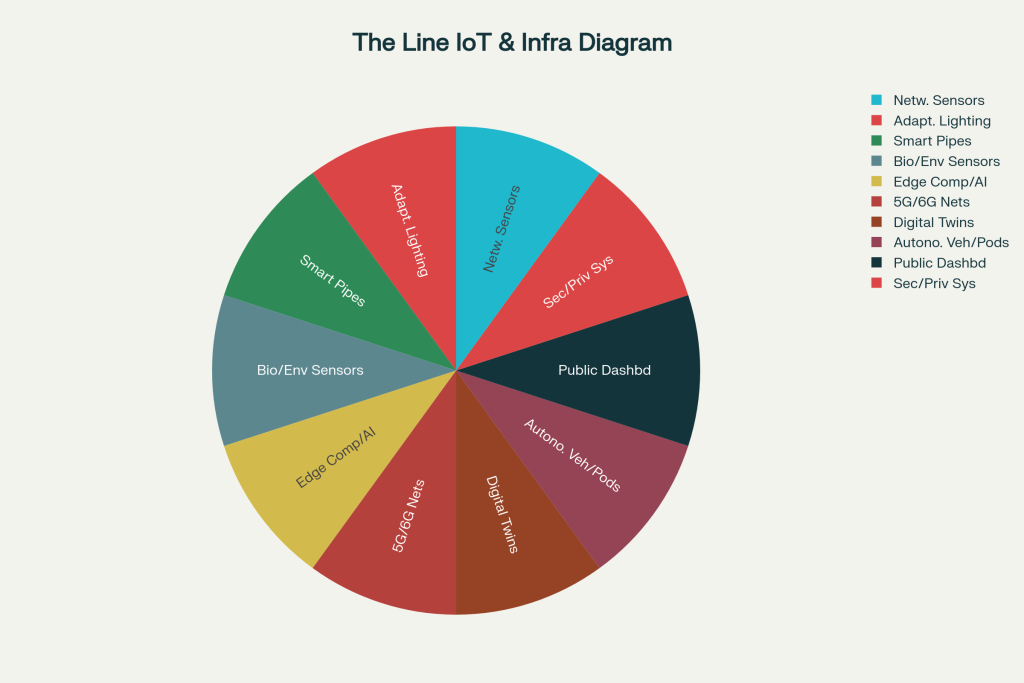
Diagram: Connected Infrastructure & IoT in The Line, Saudi Arabia
All statements and technical details in this article are drawn from leading industry and domain reports about The Line’s connected infrastructure and IoT urban solutions.[1][2]
⁂
- https://www.neom.com/en-us/regions/theline
- https://www.cloud.studio/iot-in-the-line-connected-technologies/
- https://halodetect.com/blog/iot-sensors/
- https://en.wikipedia.org/wiki/The_Line,_Saudi_Arabia
- https://www.cnbc.com/2025/07/18/saudi-arabias-the-line-at-neom-is-reviewed-as-it-considers-its-megaprojects.html
- https://line-neom.com
- https://www.irreview.org/articles/the-line-luxurious-environmentally-sustainable-infrastructure-with-a-cost
- https://www.zipitwireless.com/blog/what-are-iot-sensors-types-uses-and-examples
- https://ncusar.org/blog/2023/09/neom-the-line/
- https://www.conurets.com/iot-driven-smart-infrastructure-in-urban-life-case-studies-and-insights/
