
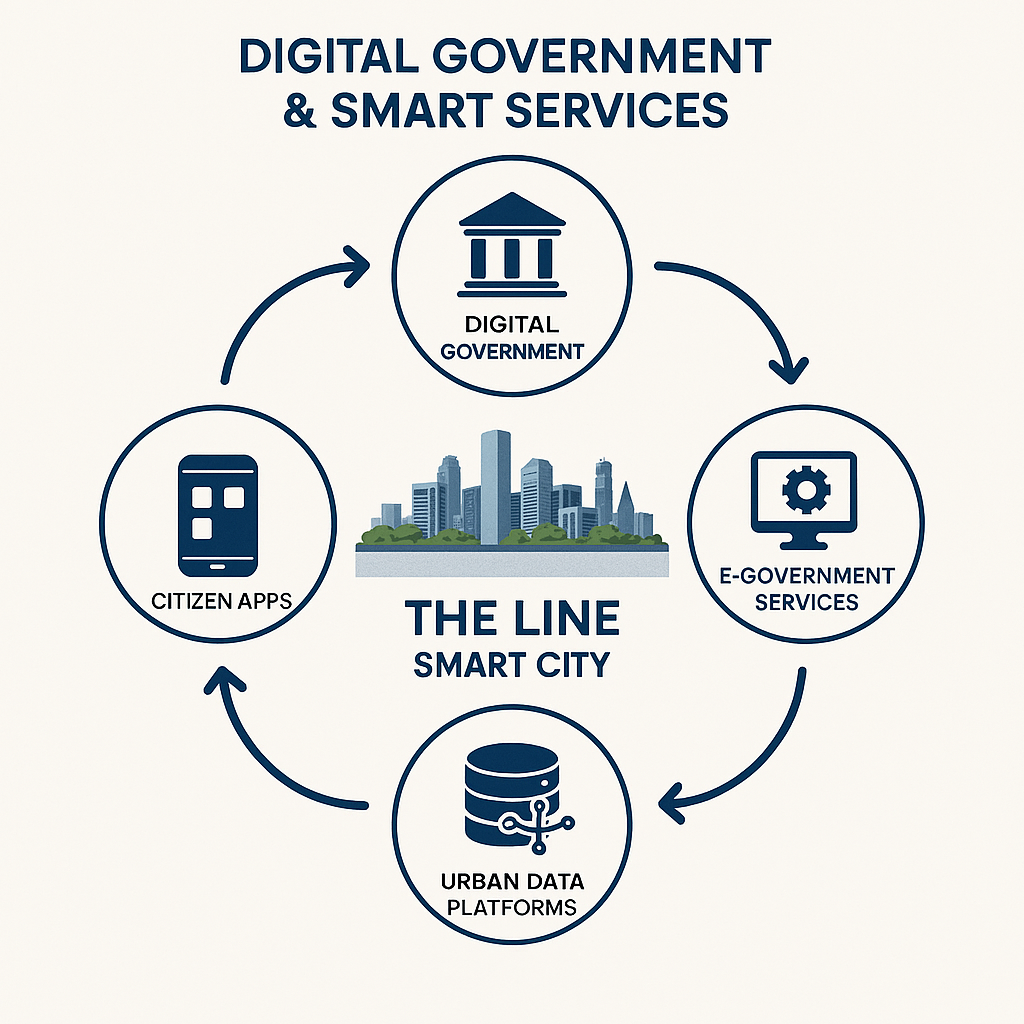

The dawn of smart cities has redefined how societies envision urban living. In Saudi Arabia, The Line—a revolutionary city under development within the NEOM region—epitomizes this transformation. At its heart is the ambition to fuse cutting-edge digital government, e-government services, citizen apps, and urban data platforms, creating an intelligent, responsive, and participatory urban habitat for residents, businesses, and policymakers alike. This article explores the vision, frameworks, tools, and real-world impacts of digital governance and smart services in The Line.[1][2]
The Vision of Digital Government in The Line
Saudi Arabia’s commitment to digital government is a cornerstone of The Line’s vision. The Digital Government Authority (DGA) leads the national drive for digitization, integrating public services and fostering a secure, citizen-centric digital ecosystem. For The Line, digital government means replacing traditional bureaucracy with seamless access to public services, real-time engagement, and streamlined communication between citizens and authorities.[3][4]
Digital government initiatives go far beyond putting forms online; they create interconnected ecosystems where data, automation, and artificial intelligence empower public administration and improve quality of life. Saudi Arabia has pioneered such transformation, ranking first globally in some e-government indicators, reflecting its proactive stance on digital innovation.[5][6]
E-Government Services: Redefining Public Service Delivery
E-government services are at the core of The Line’s smart infrastructure. Residents will experience frictionless digital interactions for every facet of civic life:
- Integrated Service Portals: Instead of visiting multiple offices, citizens access all government services—licensing, permits, welfare, education, healthcare—through a unified digital portal.[6]
- Digital Identification & Secure Access: Advanced biometric and identity-management systems allow secure, instant login for residents, businesses, and public sector users.[3][5]
- Automated Processes: AI- and data-powered workflows minimize manual paperwork, expedite approvals, and personalize government services based on user profiles and needs.[7]
- Real-Time Responsiveness: Emergency response, public safety, utility management, and urban service complaints are managed and resolved in real-time via interconnected platforms.[1]
The Line aims for zero bureaucratic friction—where residents interact with “invisible government,” meaning all service processes are digital, data-driven, and integrated across agencies.[2][1]
Citizen Apps: Empowering Urban Participation
Smart cities thrive when residents are active contributors to civic innovation. In The Line, citizen apps will be key instruments for engagement, empowerment, and collaboration:
- Smart Living Applications: A resident’s smartphone becomes the city key, enabling access to public amenities (transport, recreation, utilities), scheduling, payments, and local events.[1]
- Citizen Feedback & Co-creation: Apps allow users to report issues, suggest new facilities, participate in planning consultations, and vote on local projects, creating two-way dialogue.[7]
- Personalized Urban Experiences: Leveraging user data and preferences, apps can recommend services, community activities, and personalize notifications (e.g., traffic, health, safety).[1]
- Transactional Capabilities: Residents conduct all transactions (taxes, bills, ticketing) digitally and track their interactions with various government entities.[6]
Citizen apps are more than digital utilities—they are platforms for collective intelligence, letting every resident shape their urban environment.
Urban Data Platforms: The Backbone of Smart Services
Urban data platforms are the invisible foundation supporting The Line’s digital government. These platforms aggregate, analyze, and visualize data from countless sources—IoT sensors, citizen apps, public records, transportation networks, utilities—forming the city’s “digital nervous system”.[8][9]
- Data Integration & Sharing: All city agencies and service providers share datasets through standardized interfaces, allowing for cross-department collaboration and comprehensive decision-making.[9]
- Data Analytics & AI: Advanced analytics predict public needs, optimize energy and transport flows, and rapidly detect issues (like pollution, congestion, emergencies), while AI models enable preventive solutions.[7][1]
- Open Data Access: Citizens, startups, and researchers access anonymized urban data to develop new services, apps, or conduct research, fostering innovation and transparency.[8]
These platforms enable truly responsive government—one that senses, learns, and adapts in real time, producing smarter, safer, and more sustainable urban experiences.
Security, Privacy, and Trust: Pillars of the Digital City
With so much data centralized, robust cybersecurity and privacy protections are paramount. The Digital Government Authority enforces strict standards in data governance, personal privacy, and infrastructure security. In The Line:[4][3]
- Encrypted Communications: All citizen interactions with apps and platforms are protected by encryption and robust authentication.[3]
- Consent-Driven Data Collection: Residents control what data they share and how it is used, with transparent opt-in mechanisms.[4]
- Proactive Risk Management: AI is used to detect threats, fraud, and system vulnerabilities before they impact users.[7]
Trust becomes the cornerstone for widespread adoption and active citizen engagement.
Interoperability and Global Leadership
Saudi Arabia’s digital government vision extends beyond The Line. By embracing open standards and interoperability, The Line’s infrastructure may integrate with regional, national, and global platforms, fostering international collaboration and innovation. This positions Saudi Arabia, and The Line, as world leaders in smart city governance.[5][9][6]
Impact on Urban Life: Real Cases and Aspirations
Imagine a resident in The Line:
- She registers a new business online in minutes, receives permits automatically approved by AI systems, and accesses instant financing through integrated platforms.
- Her child’s public school records are updated in real time, and personalized educational resources arrive through secure learning apps.
- She tracks her home energy consumption, sets sustainability goals, and receives incentives for reducing carbon emissions via smart meters and apps integrated with the city’s data platform.[1]
- When a streetlight malfunctions or a public service fails, she simply snaps a photo and reports it via a citizen app, tracking resolution progress and providing feedback.
- During emergencies, she receives targeted notifications and automatic service adjustments—thanks to real-time monitoring and predictive analytics.[2][1]
These scenarios highlight the practical, transformative role of digital government and smart services in everyday city life.
Challenges and the Path Forward
Despite progress, several challenges remain:
- Digital Inclusion: Ensuring that all residents, regardless of age, language, or ability, can access and understand digital services is crucial.
- Continuous Innovation: Technology evolves rapidly; digital platforms must be updated and expanded to accommodate new needs.
- Change Management: Transitioning from traditional bureaucracy to digital-first governance requires re-training public servants, adapting legal frameworks, and managing social expectations.
- Ethical Data Use: Balancing data-driven efficiency with privacy and preventing misuse is a constant concern requiring vigilant oversight.
The Line will serve as a living laboratory for these challenges, pioneering new models for digital inclusion and ethical governance.
Looking Ahead: Toward a Global Model
The Line’s digital government and smart services approach will influence smart city design worldwide. As governments increasingly realize the benefits of “digital by default”—efficiency, transparency, citizen empowerment—the world will look to Saudi Arabia’s NEOM and The Line for best practices.
Digital government, e-government services, citizen apps, and urban data platforms are the four pillars on which cities of the future will build responsive, resilient, and inclusive societies. By investing deeply in these areas, The Line promises a paradigm shift—not only in urban living, but also in how global societies think about citizenship, governance, and innovation.[9][5][6][1]
⁂
- https://www.neom.com/en-us/regions/theline
- https://www.parsons.com/contracts/the-line-at-neom/
- https://dga.gov.sa/en/about-DGA
- https://saudipedia.com/en/article/323/government-and-politics/commissions/digital-government-authority
- https://www.spa.gov.sa/en/N2363772
- https://soulofsaudi.com/saudi-arabia-ranks-first-in-e-government-services/
- https://www.azeusconvene.com/en-sa/articles/what-is-digital-governance-saudi-arabia
- https://www.sciencedirect.com/science/article/abs/pii/S1877916617302047
- https://dga.gov.sa/en/news/digital-government-continues-whole-of-government-program



