
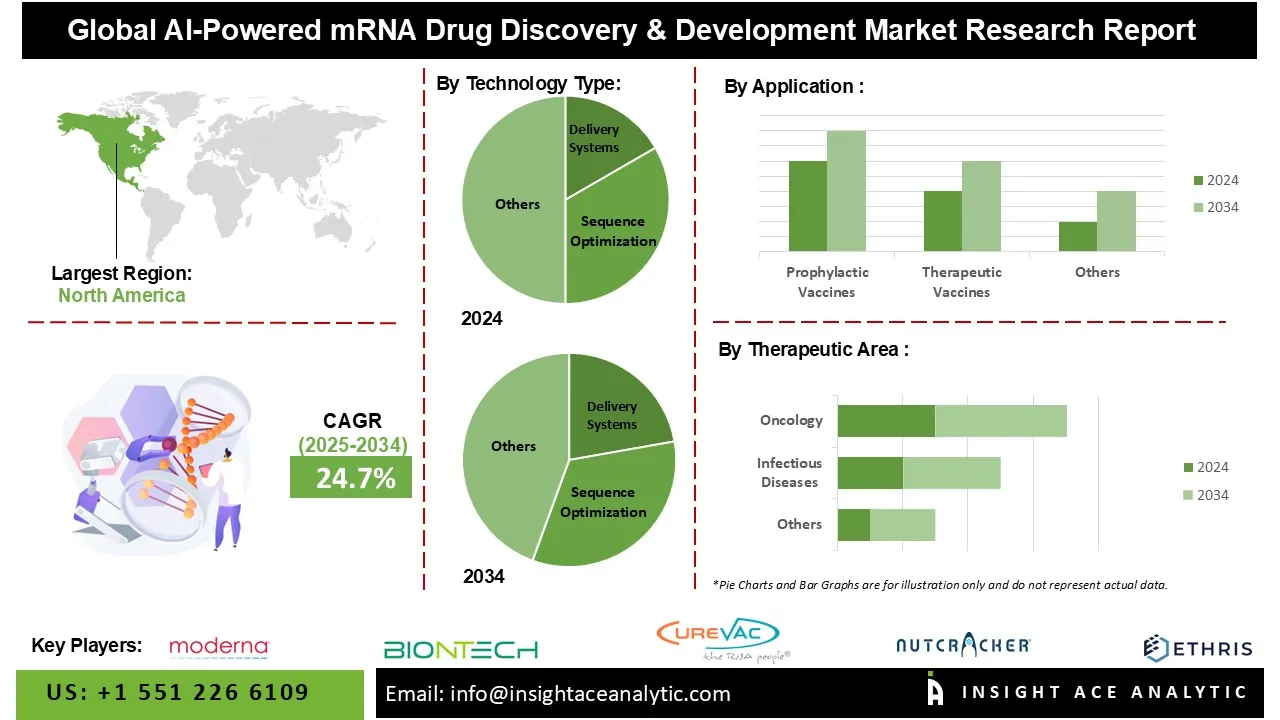

InsightAce Analytic Pvt. Ltd. announces the release of a market assessment report on the “Global AI-Powered mRNA Drug Discovery & Development Market Size, Share & Trends Analysis Report By Application (Prophylactic Vaccines, Therapeutic Vaccines, Protein Replacement Therapies, Gene Editing Support), By Therapeutic Area (Infectious Diseases, Oncology, Rare Genetic Diseases, Cardiovascular & Metabolic Disorders), By Technology Type (Sequence Optimization, Delivery Systems, Predictive Modeling, Manufacturing Optimization), By End-User (Hospitals & Clinics, Research Organizations, Pharmaceutical Companies) Market Outlook And Industry Analysis 2034”
AI-Powered mRNA Drug Discovery & Development Market Size is predicted to grow with a 24.7% CAGR during the forecast period for 2025-2034.
Get Free Access to Demo Report, Excel Pivot and ToC: https://www.insightaceanalytic.com//request-sample/ 3006
The market is entering a transformative phase as substantial partnerships, autonomous AI-driven discovery platforms, and regulatory milestones converge to reshape how mRNA-based medicines are designed, developed, and brought to patients worldwide.
The AI-powered mRNA drug discovery and development market encompasses integrated systems that leverage artificial intelligence to accelerate and optimize the design, development, production, and commercialization of mRNA-based therapeutics and vaccines. This sector combines machine learning, generative AI, foundation models, and autonomous robotic platforms to streamline the entire mRNA value chain from sequence design and lipid nanoparticle (LNP) formulation to clinical trials and large-scale manufacturing dramatically compressing timelines and improving therapeutic outcomes.
The convergence of AI and mRNA technology has reached an inflection point in 2025–2026. The biotech industry has entered what analysts describe as a “builder phase,” where AI is no longer experimental but embedded into the core of drug discovery operations. According to industry data, over 80% of biotech organizations plan to increase their AI budgets in the next 12 months, with 23% expecting to double their spend. More than 173 AI-discovered drug programs are now in clinical development globally roughly 94 in Phase I, 56 in Phase II, and 15 in Phase III with 15 to 20 programs expected to enter pivotal trials in 2026. Total global funding for AI-driven drug discovery now exceeds US$420 billion, signaling that this sector has transitioned from speculative investment to an industrialized, high-throughput discovery engine.
In the mRNA space specifically, AI is revolutionizing every stage of therapeutic design. Machine learning algorithms now optimize mRNA sequences for greater stability, translation efficiency, and immunogenicity, while generative models explore vast molecular design spaces inaccessible through conventional screening. In February 2026, researchers at the University of Toronto published a landmark study in the journal Cell describing LUMI-lab, an AI-powered autonomous platform that integrates foundation models trained on over 28 million molecular structures with robotic systems to discover next-generation lipid nanoparticles for mRNA delivery.
The platform identified a previously unknown class of brominated lipids that significantly enhance mRNA transfection efficiency a breakthrough that could unlock entirely new therapeutic applications for the mRNA platform. Meanwhile, a collaboration between the University of Texas at Austin and Sanofi produced an AI model capable of predicting mRNA protein production efficiency across different cell types, reducing dependence on costly trial-and-error experimentation.
The market is witnessing unprecedented deal-making activity that underscores the strategic importance of the AI-mRNA convergence. In March 2026, Eli Lilly signed a landmark US$2.75 billion agreement with AI drug developer Insilico Medicine the largest AI drug discovery deal to date granting Lilly exclusive global rights to develop, manufacture, and commercialize preclinical oral therapeutics identified using Insilico’s generative AI platform.
In December 2025, BioNTech completed its €1.25 billion acquisition of CureVac, consolidating two of Europe’s pioneering mRNA companies and significantly deepening its proprietary capabilities in mRNA design, delivery formulations, and manufacturing. BioNTech’s co-founders, Prof. Ugur Sahin and Prof. Özlem Türeci, subsequently announced plans to depart by end of 2026 to launch a new venture dedicated to next-generation mRNA innovations further signaling the dynamism and entrepreneurial energy in this space.
Read Comprehensive Report Overview: https://www.insightaceanalytic.com/report/ai-driven-mrna-therapeutics-market/3006
List of Prominent Players in the AI-Powered mRNA Drug Discovery & Development Market:
- Moderna
- BioNTech (including CureVac)
- Sanofi (including Translate Bio)
- Nutcracker Therapeutics
- Ethris
- Baidu (LinearDesign)
- IBM
- DeepMind (Alphabet)
- Anima Biotech
- Insilico Medicine
- Eli Lilly (AI Drug Discovery)
- Recursion Pharmaceuticals
- Other Prominent Players
Market Dynamics:
Drivers:
The market is propelled by several powerful forces converging simultaneously. The proven success of mRNA COVID-19 vaccines validated the platform globally and triggered a sustained wave of investment into next-generation applications across oncology, rare genetic diseases, and cardiovascular disorders. The escalating cost of traditional drug development averaging US$2.6 billion and 10–12 years per approved drug is pushing pharmaceutical companies to adopt AI-driven workflows that compress discovery timelines from years to months.
Insilico Medicine, for instance, moved its first AI-discovered compound from target identification to Phase I in under 30 months, compared to the industry average of 4–6 years. Substantial government and institutional funding, including from the NIH, CEPI, the UK Government (BioNTech’s £1 billion UK commitment), and programs like Operation Warp Speed, continues to accelerate research and commercialization.
The rise of autonomous self-driving laboratories (SDLs), foundation models trained on millions of molecular structures, and closed-loop AI-experiment workflows is transforming discovery from a labor-intensive process into a data-driven engineering discipline. Additionally, Moderna’s enterprise-wide adoption of generative AI through its OpenAI partnership with over 80% employee adoption demonstrates how AI is reshaping not just R&D but entire organizational operating models in the mRNA space.
Challenges:
Despite strong momentum, the market faces meaningful headwinds. High mRNA production costs, combined with the computational infrastructure required for AI-driven development, create significant barriers for smaller players multiple AI drug discovery startups shut down or announced workforce reductions exceeding 20% in 2025 despite substantial backing. Navigating evolving regulatory frameworks remains complex: the FDA’s draft AI guidance is expected to be finalized in 2026, requiring credibility assessment plans and detailed documentation for AI models used in drug development, while the EU AI Act’s high-risk provisions take effect in August 2026, potentially classifying some drug development AI as high-risk applications.
Data quality and availability remain the single biggest obstacle to AI success in drug discovery cited by 55% of organizations as the primary reason AI pilots fail and federated learning solutions to address data scarcity remain in early stages. Technical challenges in mRNA delivery, stability under varying conditions, and the gap between Phase I/II success and Phase III validation continue to temper expectations.
Regional Trends:
North America is positioned to dominate the AI-powered mRNA drug discovery market, anchored by world-class research infrastructure, the headquarters of industry leaders such as Moderna, established regulatory pathways including FDA emergency use authorizations, and major investment initiatives such as Eli Lilly and Nvidia’s joint US$1 billion AI drug discovery lab. The FDA’s forthcoming AI guidance is expected to provide additional regulatory clarity.
Europe is a formidable force, with BioNTech’s expanded R&D footprint across the UK and Germany (including its AI hub and two new R&D centers), the CureVac integration, and supportive government grants driving innovation. Asia-Pacific has emerged as a surprise leader in AI-driven drug discovery overall, with companies in the region collectively raising US$267 billion in disclosed funding surpassing North America driven by deep talent pools, strong regulatory support, and increasing access to long-term capital.
Add our site to Google Preferred Sources for quality content: https://google.com/preferences/source?q=insightaceanalytic.com
Key Developments
- March 2026: Eli Lilly signed a US$2.75 billion collaboration with Insilico Medicine the largest AI drug discovery deal in history to develop, manufacture, and commercialize AI-discovered preclinical oral therapeutics across multiple therapeutic areas. Insilico received US$115 million upfront, with the remainder tied to milestones and royalties.
- February 2026: Researchers at the University of Toronto published a study in Cell introducing LUMI-lab, an AI-powered autonomous platform that screened over 1,700 lipid nanoparticles and discovered that brominated-tail ionizable lipids not previously linked to mRNA delivery significantly enhance mRNA transfection efficiency, opening new frontiers for LNP design.
- January 2026: Moderna entered a strategic collaboration with Recordati for its rare disease mRNA therapy mRNA-3927 (propionic acidemia), with US$50 million upfront and up to US$110 million in near-term milestones, signaling the commercial viability of AI-optimized mRNA therapeutics beyond vaccines.
- December 2025: BioNTech completed its €1.25 billion acquisition of CureVac, consolidating proprietary technologies in mRNA design, delivery formulations, and manufacturing. Approximately 86.75% of CureVac shares were tendered. BioNTech’s co-founders subsequently announced plans to form a new venture focused on next-generation mRNA innovations.
- Early 2026: Moderna reported five-year follow-up data for its personalized mRNA cancer vaccine (intismeran/mRNA-4157) showing sustained benefit in high-risk melanoma, with eight Phase 2 and Phase 3 trials now underway across melanoma, NSCLC, bladder, and renal cell carcinoma. The FDA also granted expedited review with an August 5, 2026 PDUFA date for Moderna’s seasonal flu vaccine mRNA-1010.
- July 2025: The University of Texas at Austin and Sanofi developed an AI model that predicts how efficiently specific mRNA sequences produce proteins across different cell types, reducing trial-and-error experimentation and accelerating next-generation mRNA therapeutic design.
Segmentation of AI-Powered mRNA Drug Discovery & Development Market
By Application –
- Prophylactic Vaccines
- Therapeutic Vaccines
- Protein Replacement Therapies
- Gene Editing Support
By Therapeutic Area –
- Infectious Diseases
- Oncology
- Rare Genetic Diseases
- Cardiovascular & Metabolic Disorders
By Technology Type –
- Sequence Optimization
- Delivery Systems
- Predictive Modeling
- Manufacturing Optimization
By End-User –
- Hospitals & Clinics
- Research Organizations
- Pharmaceutical Companies
By Region–
North America–
- The US
- Canada
Europe–
- Germany
- The UK
- France
- Italy
- Spain
- Rest of Europe
Asia-Pacific–
- China
- Japan
- India
- South Korea
- Southeast Asia
- Rest of Asia Pacific
Latin America–
- Brazil
- Argentina
- Mexico
- Rest of Latin America
Middle East & Africa–
- GCC Countries
- South Africa
- Rest of Middle East and Africa
Customize this Study according to your Requirements @ https://www.insightaceanalytic.com/customization/3006
About Us:
InsightAce Analytic is a market research and consulting firm that enables clients to make strategic decisions. Our qualitative and quantitative market intelligence solutions inform the need for market and competitive intelligence to expand businesses. We help clients gain competitive advantage by identifying untapped markets, exploring new and competing technologies, segmenting potential markets and repositioning products. Our expertise is in providing syndicated and custom market intelligence reports with an in-depth analysis with key market insights in a timely and cost-effective manner.
Contact us:
InsightAce Analytic Pvt. Ltd.
Visit: https://www.insightaceanalytic.com/
Tel : +1 607 400-7072
Asia: +91 79 72967118
info@insightaceanalytic.com



