
The Line, at the core of the NEOM development in northwestern Saudi Arabia, is an urban experiment unlike any other on Earth—a linear city designed to transform the concept of civilization itself. Envisioned as a 170-kilometer-long, 500-meter-high, and 200-meter-wide superstructure, The Line aims to accommodate up to nine million residents, making it not only one of the most ambitious architectural projects in human history but a testbed for the future of sustainable and connected urban living.[1][2][3]
Concept and Design
The Line disrupts conventional city planning, favoring a vertical and ultra-compact footprint that maximizes land preservation, with 95% of its area reserved for nature. The “mirror landscape” of The Line, with its vast glass-clad facades, reflects the surrounding desert, merging the city visually with its environment while physically separating it from the wilderness—showcasing architectural innovation and aesthetic ambition.[2][4][1]
The city’s organization is revolutionary: three layers—one dedicated to pedestrians and residential life, a second hosting infrastructure, and a third for ultra-high-speed transit. There will be no cars, no roads, and zero carbon emissions. Instead, The Line will rely exclusively on renewable energy, from solar to wind power, and everything needed for daily life will be accessible within a five-minute walk.[3][2]
Multi-level vertical stacking creates a new kind of urban density. Everyday amenities such as schools, shops, medical facilities, and green spaces are interwoven. Artificial intelligence will integrate and optimize city services as residents interact with environments that aren’t just “smart,” but predictive—data submitted by citizens is planned to help continually refine city operations.[1][2]
Construction and Progress
Announced in 2021 as a flagship of Saudi Arabia’s Vision 2030, The Line was initially promoted as a fully completed mega-city by 2030. The reality, though ambitious, has shifted toward a phased approach, with the first segment—known as the “Hidden Marina”—targeted for completion by 2030 to house around 200,000 residents. This portion will include 9,000 hotel rooms, shops, cultural centers, and full community infrastructure.[4][5]
As of 2025, construction progress is visible on the ground. Drone photos reveal vast earthworks, trenches, and massive concrete foundations spreading along the desert, accompanied by intense activity—260 excavators and 2,000 trucks moving material and forming the groundwork of the city. The project’s scale is astounding: NEOM currently uses about 20% of all steel produced internationally, and an on-site concrete plant can churn out 700,000 cubic feet per day.[5][4]
Despite the sheer quantity of resources deployed, technical and financial challenges are mounting. Cost projections have soared, with some sources citing up to $8.8 trillion for full completion by 2080—vastly more than prior estimates. The Saudi government states the first phase alone will require $370 billion by 2035, with hopes for private investment to eventually supplement government funding. Saudi Arabia’s sovereign wealth fund remains the primary backer, but recent reports suggest some projects have been scaled back due to delays, cost overruns, and shifting priorities amid fluctuating oil prices and global economic uncertainty.[3][1]
Technology, Infrastructure, and Innovation
At its core, The Line represents a technological and infrastructural leap forward. Beneath its gleaming pedestrian spaces, a subterranean layer will contain a high-speed rail network, capable of linking both ends of the city in just 20 minutes. The absence of cars enables a total reimagining of urban life: air quality is protected, noise pollution minimized, and the entire city powered by renewable sources.[1]
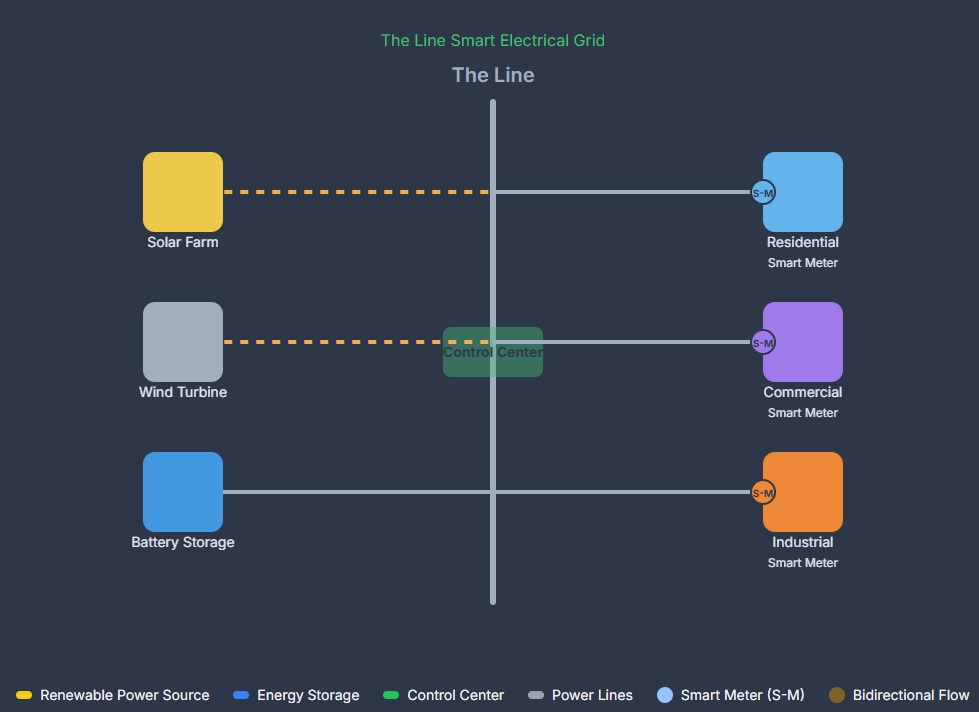
Digitization touches every aspect, as smart buildings, integrated sensors, and artificial intelligence will optimize energy usage, waste management, transportation, and even human health—making The Line a “living laboratory” for the future of smart cities. Residents will actively participate in this network, being paid to submit data that further refines algorithms for city management, a radical shift in urban governance.[2][1]
Social and Economic Aspirations
The Line is a linchpin in Saudi Arabia’s Vision 2030—a strategic plan to reduce the kingdom’s dependence on oil and propel it toward a diversified, knowledge-based economy. Specifically, The Line is projected to generate 460,000 jobs and contribute $48 billion to domestic GDP by 2030. The city will attract global investment, foster educational and technological innovation, and lure top-tier talent, making Saudi Arabia a magnet for those seeking the next frontier in urban living.[2][1]
If fully realized, The Line will have a population density six times higher than the densest city in the world, Manila. This density will be made livable by the stacking of built environments, minimizing travel time, and integrating green spaces throughout the city, offering unprecedented efficiency and lifestyle choices.[4][1]
Environmental Impact and Criticisms
While sustainability is a central theme—zero emissions, land preservation, renewable energy, and advanced waste management—the project faces significant scrutiny. Environmental experts and human rights organizations have raised concerns over habitat disruption and displacement of native peoples, particularly tribal communities living in the NEOM region. Construction at this scale inevitably transforms the landscape in profound ways, and it is uncertain if the pledges to preserve ecosystems will be fully realized in practice.[4]
Human rights criticism centers on forced relocations and the rights of those living in the Tabuk province. Furthermore, some observers question whether technological solutions are advanced enough to make the city’s ambitious infrastructure feasible—especially artificial intelligence integration at such a massive scale.[3][4]
Adjustments and Future Prospects
By 2025, The Line’s initial vision has evolved. A phased and more realistic approach is now preferred, focusing first on the Hidden Marina segment as a model district. This allows Saudi planners to test infrastructure, refine technologies, and manage resources before launching further expansion. If this prototype district succeeds—balancing operational realities with technological aspirations—the plan is to expand The Line in segments, potentially stretching past 100 kilometers and housing millions by 2045 or later.[5][1]
The focus on modular expansion, rather than an “all-at-once” strategy, is intended to bolster investor confidence and allow for technological improvements as the city grows. Global architecture and engineering firms, including Morphosis, Delugan Meissl, and Gensler, contribute expertise, but some face mounting pressure to reconsider involvement amid controversy.[4]
Global Significance
The Line has captured global attention, not just for its record-breaking scale but as a symbol of both the promise and perils of future urbanization. For supporters, it heralds a new era of sustainable, walkable, AI-powered cities that may offer solutions to humanity’s greatest challenges—urban sprawl, pollution, resource scarcity, and climate change. For critics, it is a costly, potentially unfeasible vision that raises questions about ethics, ecology, and the real capacity for transformative change.[2][3]
Whether The Line becomes a thriving metropolis or a cautionary tale, its influence on architecture, urban planning, and sustainability will be lasting. From its mirrored façade to its laboratories for future technologies, The Line at NEOM is poised to redefine what a city can be—and what it should aspire to achieve in the 21st century and beyond.[5][1][3][4]
⁂
- https://en.wikipedia.org/wiki/The_Line,_Saudi_Arabia
- https://www.neom.com/en-us/regions/theline
- https://www.cnbc.com/2025/07/18/saudi-arabias-the-line-at-neom-is-reviewed-as-it-considers-its-megaprojects.html
- https://www.dezeen.com/2025/04/25/concrete-construction-progress-the-line-megacity/
- https://www.youtube.com/watch?v=4JI5I4NjV-U
- https://www.youtube.com/watch?v=fcYQiAMoYJw&vl=en
- https://www.youtube.com/watch?v=v3AT2sQkYoI
- https://www.neom.com/en-us



